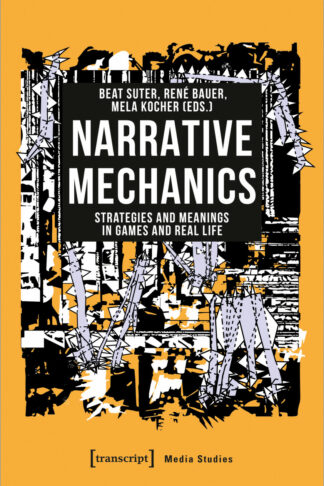
Narrative Mechanics. Strategies and Meanings in Games and Real Life | Beat Suter, René Bauer, Mela Kocher (eds.) [E-Book PDF]
What do stories in games have in common with political narratives?
This book identifies narrative strategies as mechanisms for meaning and manipulation in games and real life. It shows that the narrative mechanics so clearly identifiable in games are increasingly used (and abused) in politics and social life. They have »many faces«, displays and interfaces. They occur as texts, recipes, stories, dramas in three acts, movies, videos, tweets, journeys of heroes, but also as rewarding stories in games and as narratives in society – such as a career from rags to riches, the concept of modernity or market economy. Below their surface, however, narrative mechanics are a particular type of motivational design – of game mechanics.
Was haben Geschichten in Spielen mit politischen Erzählungen gemeinsam?
17 Autor:innen widmen sich dieser Frage und veranschaulichen, wie die in Spielen so klar identifizierbaren narrativen Mechanismen zunehmend in der Politik und im gesellschaftlichen Leben eingesetzt (und missbraucht) werden. Die Publikation versammelt Beiträge der jährlich stattfindenden Konferenz gameZ & ruleZ sowie von weiteren Autor:innen aus der Fachrichtung Game Design.
Narrative Mechanics. Strategies and Meanings in Games and Real Life | Beat Suter, René Bauer, Mela Kocher (eds.)
CHF 51.50
What do stories in games have in common with political narratives?
This book identifies narrative strategies as mechanisms for meaning and manipulation in games and real life. It shows that the narrative mechanics so clearly identifiable in games are increasingly used (and abused) in politics and social life. They have »many faces«, displays and interfaces. They occur as texts, recipes, stories, dramas in three acts, movies, videos, tweets, journeys of heroes, but also as rewarding stories in games and as narratives in society – such as a career from rags to riches, the concept of modernity or market economy. Below their surface, however, narrative mechanics are a particular type of motivational design – of game mechanics.
Selbsttransformation und charismatisch evangelikale Identität | Francis Müller
CHF 71.00
Eine vergleichende ethnosemantische Lebenswelt-Analyse
Francis Müller untersucht mit einem ethnosemantischen Ansatz eine schweizerische und eine ghanaische charismatisch evangelikale Gemeinschaft im Großraum Zürich. Als zentrales Element kristallisiert sich in den zwei Gemeinschaften die Konversion und die damit verbundene Selbsttransformation heraus, welche in den zwei Gemeinschaften mit unterschiedlichen kulturellen Themen in Verbindung gebracht wird. Die erstrebte radikale Selbsttransformation ist riskant, weil sie den Bruch mit Gewohnheiten und dem bisherigen Leben impliziert. Es werden in den zwei Gemeinschaften unterschiedliche Techniken und normative Identitäten vermittelt, die zeigen, wie mit dieser Diskontinuität umzugehen und wie überhaupt in einer modernen, säkularen Welt zu leben ist. Der Autor leistet so einen Beitrag zur soziologischen Konversionsforschung.
Fines Hominis? Zur Geschichte der philosophischen Anthropologiekritik | Marc Rölli (Hg.)
CHF 37.50
Seit bereits gut 50 Jahren geistern in der Philosophie die Thesen vom «Verschwinden des Menschen», seiner «Auflösung» oder seinem «Ende» herum. Vom «Tod des Subjekts» ist immer wieder die Rede. Es etabliert sich eine philosophische Skepsis, die sich auf «den Menschen» bezieht und über ihn hinausweist. Dieses Buch klärt über die Hintergründe und Bedeutungen dieser als «postmodern» geltenden Postulate auf, ohne dabei in polemische Vorurteile zu verfallen. In den einzelnen Beiträgen werden die historisch einschlägigen Kritiken rekonstruiert, die sich gegen eine anthropologische Erhöhung oder Verabsolutierung «des Menschen» aussprechen. Zugleich bezieht der Band philosophisch Position gegen den aktuellen Trend einer Wiederbelebung naturalistischer Menschenbilder in Biowissenschaften und Hirnforschung.
232 Seiten, transcript, 2015
ISBN 978-3-8376-2956-9
No style | Peter Vetter, Katharina Leuenberger, Meike Eckstein
CHF 55.00
Ernst Keller (1891-1968). Teacher and pioneer of the Swiss Style
In various different places, particularly in the USA, when writing the history of graphic design, Ernst Keller is referred to as the father of Swiss Style, later International Typographic Style. This is down to the large number of Keller students, who later shaped this Swiss Style and made it famous. Keller’s achievement is shown purely using his oeuvre, primarily his poster designs and his work on lettering and graphic design in architecture.
Ernst Keller’s contribution to the development of innovative, non-academic didactic principles in design training plays a fundamental role. His teaching activity starting in 1918 can be defined as one of the first systematic training programmes for graphic design in the world.
253 pages, Triest Verlag, 2017
ISBN 978-3-0-3863023-4

![Narrative Mechanics. Strategies and Meanings in Games and Real Life | Beat Suter, René Bauer, Mela Kocher (eds.) [E-Book PDF]](https://publikationen.zhdk.ch/wp-content/uploads/2022/03/Narrative-Mechanics.jpg)