Beschreibung
ZHdK: Institute for the Performing Arts and Film (IPF)
![Acoustics of the Vowel. Preliminaries | Dieter Maurer [E-Book PDF]](https://publikationen.zhdk.ch/wp-content/uploads/2019/04/medium-2.jpg)
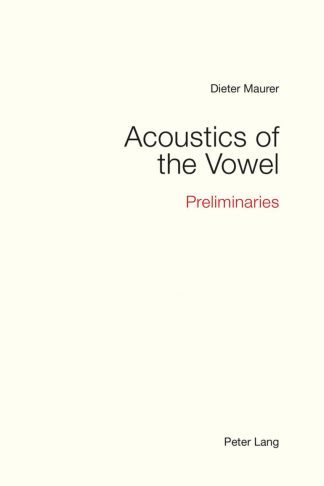
It seems as if the fundamentals of how we produce vowels and how they are acoustically represented have been clarified: we phonate and articulate. Using our vocal chords, we produce a vocal sound or noise which is then shaped into a specific vowel sound by the resonances of the pharyngeal, oral, and nasal cavities, that is, the vocal tract. Accordingly, the acoustic description of vowels relates to vowelspecific patterns of relative energy maxima in the sound spectra, known as patterns of formants. The intellectual and empirical reasoning presented in this treatise, however, gives rise to scepticism with respect to this understanding of the sound of the vowel. The reflections and materials presented provide reason to argue that, up to now, a comprehensible theory of the acoustics of the voice and of voiced speech sounds is lacking, and consequently, no satisfying understanding of vowels as an achievement and particular formal accomplishment of the voice exists. Thus, the question of the acoustics of the vowel – and with it the question of the acoustics of the voice itself – proves to be an unresolved fundamental problem.
subTexte 12
280 pages, Peter Lang, 2016
978-3-0343-2391-8
ZHdK: Institute for the Performing Arts and Film (IPF)
It seems as if the fundamentals of how we produce vowels and how they are acoustically represented have been clarified: we phonate and articulate. Using our vocal chords, we produce a vocal sound or noise which is then shaped into a specific vowel sound by the resonances of the pharyngeal, oral, and nasal cavities, that is, the vocal tract. Accordingly, the acoustic description of vowels relates to vowelspecific patterns of relative energy maxima in the sound spectra, known as patterns of formants. The intellectual and empirical reasoning presented in this treatise, however, gives rise to scepticism with respect to this understanding of the sound of the vowel. The reflections and materials presented provide reason to argue that, up to now, a comprehensible theory of the acoustics of the voice and of voiced speech sounds is lacking, and consequently, no satisfying understanding of vowels as an achievement and particular formal accomplishment of the voice exists. Thus, the question of the acoustics of the vowel – and with it the question of the acoustics of the voice itself – proves to be an unresolved fundamental problem.
subTexte 12
280 pages, Peter Lang, 2016
978-3-0-3432031-3
![Akustik des Vokals. Präliminarien | Dieter Maurer [E-Book PDF]](https://publikationen.zhdk.ch/wp-content/uploads/2020/03/subTexte_08_Akustik_des_Vokals-324x486.jpg)

Die Frage, wie wir Vokale erzeugen und wie sie sich in der Folge akustisch «abbilden», scheint im Wesentlichen geklärt: Wir phonieren und artikulieren. Wir produzieren mit den Stimmbändern einen allgemeinen Klang oder ein Geräusch und formen diese über die Resonanzen von Rachen, Mund und Nase zu einem einzelnen, spezifischen Laut. Dementsprechend werden Vokale akustisch über charakteristische Energiemaxima im Spektrum, über sogenannte «Formanten» beschrieben. Intellektuelle und empirische Gründe, wie sie in dieser Schrift zusammengestellt und erläutert werden, geben aber Anlass zu einer ausgeprägten Skepsis gegenüber einer solchen Auffassung. Die vorliegenden Darstellungen und Erläuterungen lassen folgern, dass eine nachvollziehbare Theorie der Akustik von Stimme und stimmhafter Sprache, und mit ihr ein entsprechendes Verstehen von Vokalen als Leistung und Formgebung der Stimme, bis heute aussteht. Die Frage nach der Akustik der Vokale erweist sich mithin als ein ungelöstes Grundlagenproblem.
subTexte 08
112 Seiten, Institute for the Performing Arts and Film ZHdK, 2012
ISBN 978-3-906437-39-2
Printausgabe vergriffen
Experten, Amateure, behinderte Darsteller im Gegenwartstheater
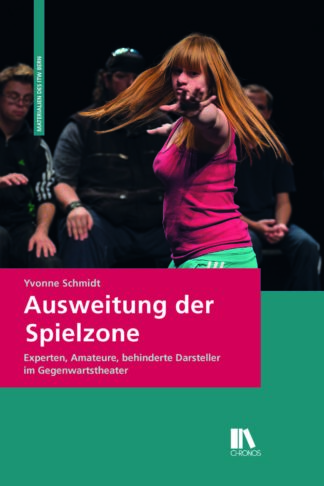
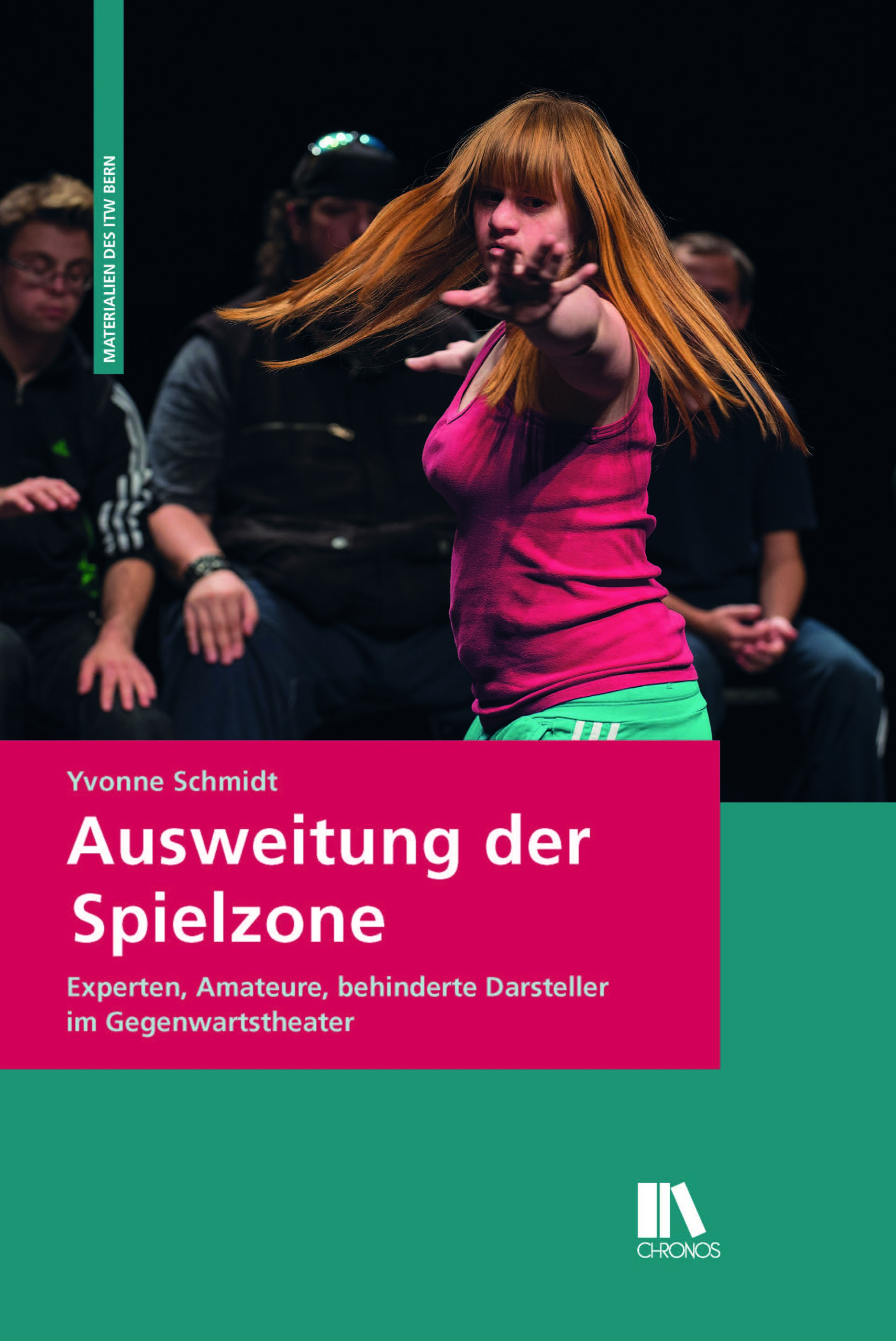
Seit den 1990er Jahren treten vermehrt Darsteller auf den Bühnen des professionellen Theaters auf, die den Kriterien für Berufsschauspieler eigentlich nicht entsprechen. Unter welchen Prämissen tauchen diese Darsteller ohne Schauspielschuldiplom in der Theaterlandschaft auf? Der Bogen reicht vom Spiel mit Authentizität über die Teilhabe marginalisierter Gruppen bis hin zu den «Freaks» bei Christoph Schlingensief und den Darsteller des Theaters Hora, professionellen Darstellern mit einer geistigen Behinderung.
Das Buch zeichnet das heterogene Phänomen der Laien im Gegenwartstheater nach: von den Experten des Alltags (Rimini Protokoll) bis hin zu Bürgerbühnen, die das Theater mit Laien institutionalisierten. In den Fokus rücken auch andere Formen der Theaterpraxis, die in einem spannungsreichen Kontrast zum «Expertentheater» stehen: das lebendige Amateurtheater der Schweiz und Theater von und mit behinderten Darstellern. Während im Freilichttheater oft Profis mit Laien zusammenarbeiten und sich Mischformen von professionellem und Amateurtheater herausbilden, stehen im Behindertentheater nicht nur ästhetische Normen, sondern auch dem Schauspieldiskurs eingeschriebene Körper- und Menschenbilder auf dem Prüfstand.
Die ebenso wissenschaftlich präzise wie praxisnahe Studie beleuchtet nichtprofessionelle Darsteller als Schnittstelle einer wechselseitigen Annäherung von Alltagstheater und Theaterkunst in Bezug auf gegenseitige Durchdringung, aber auch im Hinblick auf die Eigenheiten verschiedener Theaterpraxen.
subTexte 17
224 Seiten, Chronos, 2020
ISBN 978-3-0-3401312-3
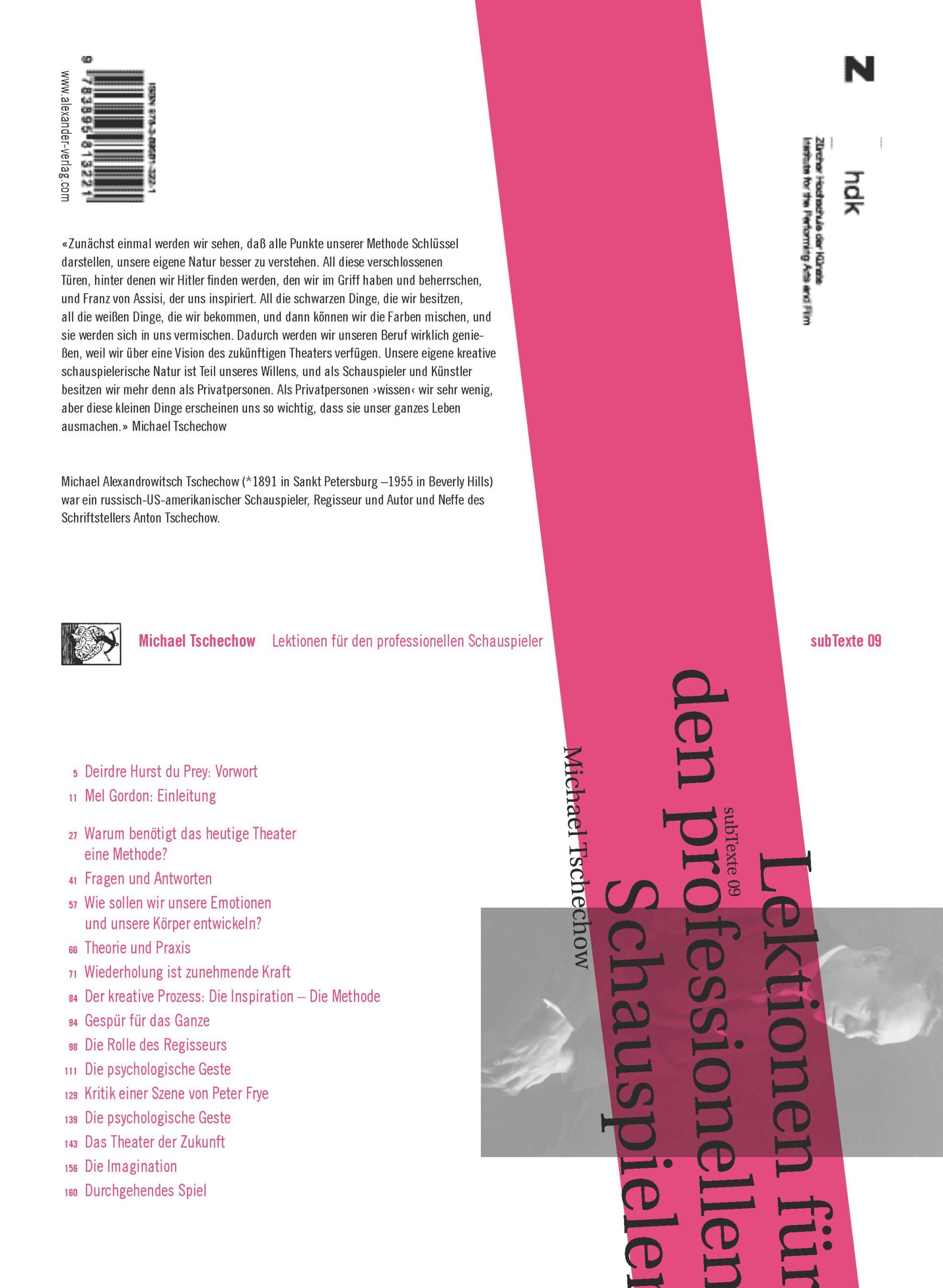
Nach Notizen transkribiert und zusammengestellt von Deirdre Hurst du Prey.
Michael Tschechows anregende Lektionen bieten einen Einstieg in seine Methoden und Techniken zur Erschließung des imaginativen Potenzials des Schauspielers. Der 1985 in New York veröffentlichte Text erscheint hier erstmals auf Deutsch, übersetzt von Michael Raab.
subTexte 09
172 Seiten, Alexander Verlag, 2013
ISBN 978-3-89581-322-1
Printausgabe vergriffen
![Künstlerische Forschung. Positionen und Perspektiven | Anton Rey, Stefan Schöbi (Hg.) [E-Book PDF]](https://publikationen.zhdk.ch/wp-content/uploads/2020/03/subTexte_03_Künstlerische_Forschung-324x486.jpg)
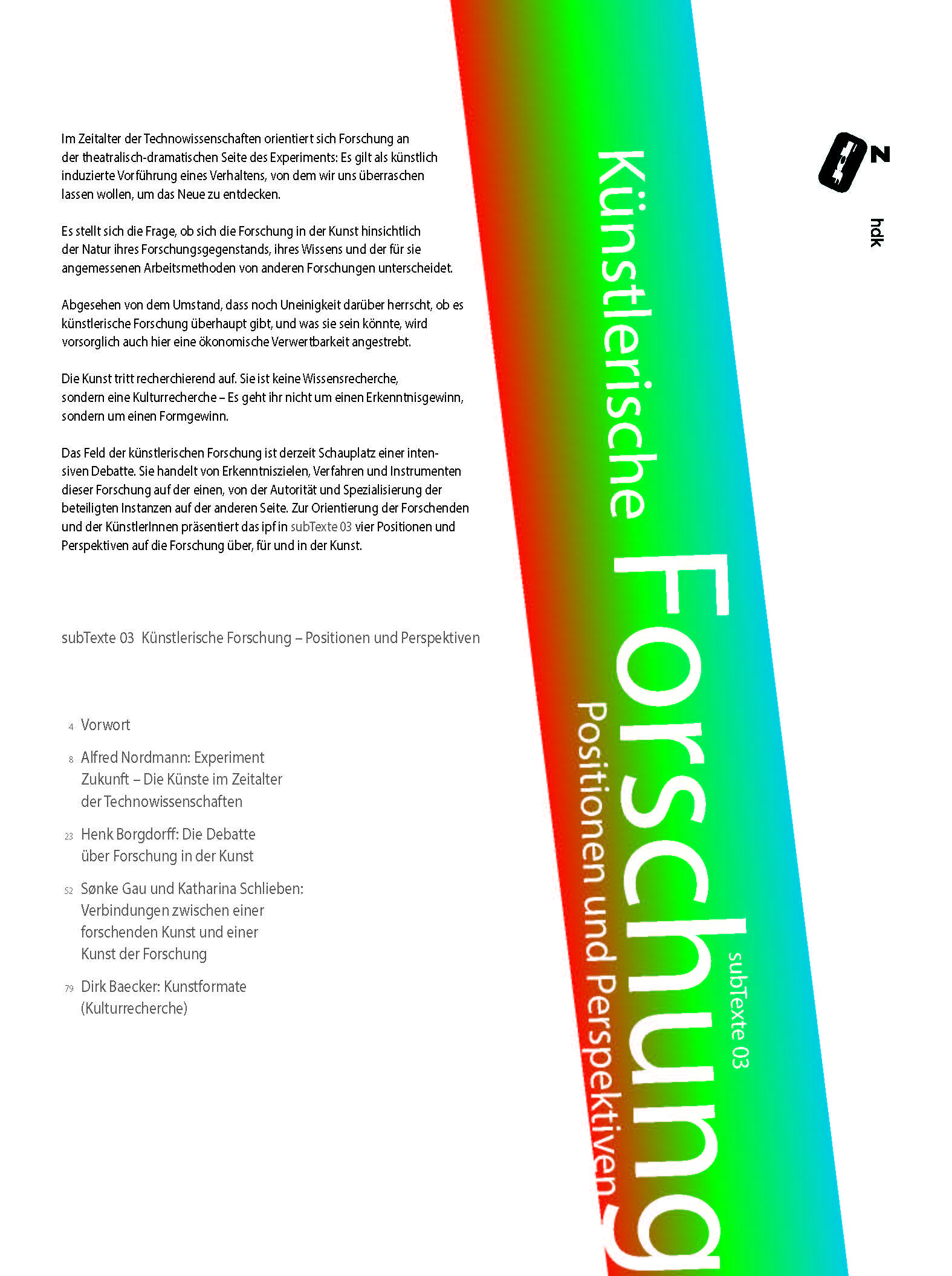
Künstlerische Forschung ist derzeit der Ort ener heftigen Debatte: einerseits über die erkenntnistheoretischen Ziel, Verfahren und Instrumente dieser Forschung; zum anderen über die Autorität und Spezialisierung derjenigen, die zu diesem Bereich beitragen. SubTexte 03 dient als Orientierungshilfe für Forscher und Künstler und sammelt vier Positionen und Perspektiven der Forschung in, für und innerhalb der Kunst. Mit Beiträgen von Dirk Baecker, Henk Borgdorff, Sønke Gau, Alfred Nordmann, Katharina Schlieben.
subTexte 03
52 Seiten (PDF), Institute for the Performing Arts and Film ZHdK, 2009
ISBN 978-3-906437-30-9
Printausgabe vergriffen