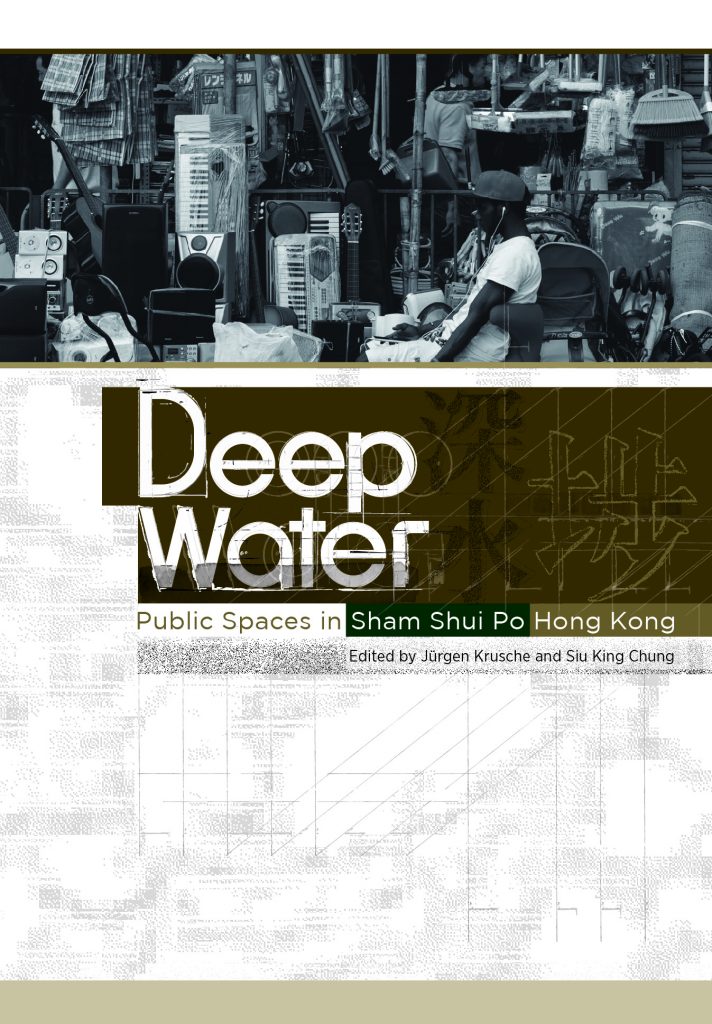
Deep Water | Jürgen Krusche, Siu King Chung (eds.)
Public Spaces in Sham Shui Po, Hong Kong
In strongly globalized cities there are fast transformation processes on the move, reinforced by the neo-liberal policies and the resulting economic, social, urban and cultural policy strategies. From a research perspective, a main question is how to capture, describe and interpret such developments taking place at a fast pace.
Researchers and artsts from Hong Kong and Zurich worked together in a small area of Sham Shui Po, one of the poorest and still most traditional Districts of Hong Kong, to investigate its public spaces according to topics of urban transformation and gentrification.
Claim. Reclaim. Occupy. Enlarge. Extend. These are everyday words in Hong Kong.
In the high density district of Sham Shui Po, which translates as Deep Water Pier for its former maritime importance, the people tend to be friendly, community-minded, resourceful, and down-to-earth. They also, statistically, have the lowest incomes in Hong Kong.
The area has been changing for decades, centuries. The post-war factories have all relocated to Mainland China. The temple for Tin Hau, the goddess of the sea, was erected near the harbour in 1901 yet today, the goddess looks out at hawkers selling second-hand electronics.
Regulations for urban public spaces of pavements, alleys, and streets in Hong Kong are sometimes negotiable. It can be unclear what is legal in Sham Shui Po. Can carpenters carry out their work on the footpath? Can a homeless person leave belongings in front of a bank? Can trash pickers store their items on the streets? Deep Water explores this “politics of space”, undoubtedly an idiosyncratic beauty of the city.
ZHdK: Institute for Contemporary Art Research (IFCAR)
Deep Water | Jürgen Krusche, Siu King Chung (eds.) [E-Book PDF]
Public Spaces in Sham Shui Po, Hong Kong
In strongly globalized cities there are fast transformation processes on the move, reinforced by the neo-liberal policies and the resulting economic, social, urban and cultural policy strategies. From a research perspective, a main question is how to capture, describe and interpret such developments taking place at a fast pace.
Researchers and artsts from Hong Kong and Zurich worked together in a small area of Sham Shui Po, one of the poorest and still most traditional Districts of Hong Kong, to investigate its public spaces according to topics of urban transformation and gentrification.
Im Zentrum der Publikation Nachtschichten stehen elf Audiokunstwerke, die im Rahmen des Forschungsprojekts NOW II an der Zürcher Hochschule der Künste von elf Künstlerinnen und Künstlern entwickelt und 2006 von Radio LoRa in Zürich ausgestrahlt wurden. Die Beiträge erkunden neue Methoden und Techniken, um mit extrem langen Werk- und Sendedauern künstlerisch operieren zu können. Die drei CDs enthalten repräsentative Ausschnitte der Radioarbeiten. (dt./engl.)
Bureau Savamala Belgrade | Jürgen Krusche, Philipp Klaus (eds.)
CHF 41.50
Urban Research and Practice in a Fast-changing Neighborhood
Savamala, ein traditionsreicher, seit den 1950er Jahren jedoch vernachlässigter Stadtteil Belgrads erfährt seit einiger Zeit einen raschen Wandel. Die Untersuchungen des Bureau Savamala von 2013 und 2014 zeigen die Veränderungen Savamalas sowohl in materieller und soziökonomischer Hinsicht als auch in der Wahrnehmung von Bewohnern und Besuchern Savamalas. Auf Basis der Ergebnisse werden die Möglichkeiten einer sanften und die Grenzen einer gesteuerten Aufwertung diskutiert. Gleichzeitig stellen einheimische Architekten, Künstler und Kulturschaffende ihre Projekte vor, die – zum Teil zusammen mit den Anwohnern – dazu beitragen sollen, Savamala auch ohne Gentrifizierung zu erneuern. (engl./serb.)
Marcel Duchamp – Die Schriften | Serge Stauffer (Hg.)
CHF 78.00
Zu Lebzeiten veröffentlichte Texte übersetzt, kommentiert und herausgegeben von Serge Stauffer. Ergänzt mit den Annotationen von Serge Stauffer, die er 1982-89 in der Erstausgabe hinterliess, einem Vorwort von Herbert Molderings und einem Nachwort von Michael Hiltbrunner.
Reprint der 1981 erschienen, vergriffenen Ausgabe. Limitierte Auflage von 1200 Exemplaren.
350 Seiten, Regenbogen Verlag, 2018
ISBN 978-3-85862-729-2

![Deep Water | Jürgen Krusche, Siu King Chung (eds.) [E-Book PDF]](https://publikationen.zhdk.ch/wp-content/uploads/2019/04/Deep-water-cover_output_-final-01-712x1024-1-324x486.jpg)