
Beschreibung
ZHdK: Institute for the Performing Arts and Film (IPF)
It seems as if the fundamentals of how we produce vowels and how they are acoustically represented have been clarified: we phonate and articulate. Using our vocal chords, we produce a vocal sound or noise which is then shaped into a specific vowel sound by the resonances of the pharyngeal, oral, and nasal cavities, that is, the vocal tract. Accordingly, the acoustic description of vowels relates to vowelspecific patterns of relative energy maxima in the sound spectra, known as patterns of formants. The intellectual and empirical reasoning presented in this treatise, however, gives rise to scepticism with respect to this understanding of the sound of the vowel. The reflections and materials presented provide reason to argue that, up to now, a comprehensible theory of the acoustics of the voice and of voiced speech sounds is lacking, and consequently, no satisfying understanding of vowels as an achievement and particular formal accomplishment of the voice exists. Thus, the question of the acoustics of the vowel – and with it the question of the acoustics of the voice itself – proves to be an unresolved fundamental problem.
subTexte 12
280 pages, Peter Lang, 2016
978-3-0-3432031-3
ZHdK: Institute for the Performing Arts and Film (IPF)
![Akustik des Vokals. Präliminarien | Dieter Maurer [E-Book PDF]](https://publikationen.zhdk.ch/wp-content/uploads/2020/03/subTexte_08_Akustik_des_Vokals-324x486.jpg)

Die Frage, wie wir Vokale erzeugen und wie sie sich in der Folge akustisch «abbilden», scheint im Wesentlichen geklärt: Wir phonieren und artikulieren. Wir produzieren mit den Stimmbändern einen allgemeinen Klang oder ein Geräusch und formen diese über die Resonanzen von Rachen, Mund und Nase zu einem einzelnen, spezifischen Laut. Dementsprechend werden Vokale akustisch über charakteristische Energiemaxima im Spektrum, über sogenannte «Formanten» beschrieben. Intellektuelle und empirische Gründe, wie sie in dieser Schrift zusammengestellt und erläutert werden, geben aber Anlass zu einer ausgeprägten Skepsis gegenüber einer solchen Auffassung. Die vorliegenden Darstellungen und Erläuterungen lassen folgern, dass eine nachvollziehbare Theorie der Akustik von Stimme und stimmhafter Sprache, und mit ihr ein entsprechendes Verstehen von Vokalen als Leistung und Formgebung der Stimme, bis heute aussteht. Die Frage nach der Akustik der Vokale erweist sich mithin als ein ungelöstes Grundlagenproblem.
subTexte 08
112 Seiten, Institute for the Performing Arts and Film ZHdK, 2012
ISBN 978-3-906437-39-2
Printausgabe vergriffen
![Acoustics of the Vowel. Preliminaries | Dieter Maurer [E-Book PDF]](https://publikationen.zhdk.ch/wp-content/uploads/2019/04/medium-2-324x486.jpg)
It seems as if the fundamentals of how we produce vowels and how they are acoustically represented have been clarified: we phonate and articulate. Using our vocal chords, we produce a vocal sound or noise which is then shaped into a specific vowel sound by the resonances of the pharyngeal, oral, and nasal cavities, that is, the vocal tract. Accordingly, the acoustic description of vowels relates to vowelspecific patterns of relative energy maxima in the sound spectra, known as patterns of formants. The intellectual and empirical reasoning presented in this treatise, however, gives rise to scepticism with respect to this understanding of the sound of the vowel. The reflections and materials presented provide reason to argue that, up to now, a comprehensible theory of the acoustics of the voice and of voiced speech sounds is lacking, and consequently, no satisfying understanding of vowels as an achievement and particular formal accomplishment of the voice exists. Thus, the question of the acoustics of the vowel – and with it the question of the acoustics of the voice itself – proves to be an unresolved fundamental problem.
subTexte 12
280 pages, Peter Lang, 2016
978-3-0343-2391-8
![Theater Vermittlung Schule | Mira Sack, Anton Rey, Stefan Schöbi (Hg.) [E-Book PDF]](https://publikationen.zhdk.ch/wp-content/uploads/2019/05/subTexte_05_Theater_Vermittlung-324x486.jpg)
Theater und Schule erschienen angesichts ihrer unterschiedlichen Strukturen und Arbeitsweisen als ziemlich gegensätzliches Paar: hier die engen Leitplanken der Lehrpläne, dort die Freiheit der Kunst. Dennoch verfolgen die beiden Institutionen vergleichbare Ziele, setzen zu deren Erreichung aber unterschiedliche Instrumente ein. Der Auftrag der kulturellen Bildung und Kulturvermittlung an die nachwachsende Generation kann jedoch nur von Schule und Theater gemeinsam geleistet werden.
subTexte 05
64 Seiten, Institute for the Performing Arts and Film ZHdK, 2011
ISBN 978-3-906437-34-7
Printausgabe vergriffen
Untersuchungen zum Theater mit nicht professionellen Darstellenden der deutschsprachigen Schweiz
Forschungsbericht zum SNF/DORE-Forschungsprojekt
Die Studie untersucht das aktuelle Freilichttheaterschaffen im Hinblick auf künstlerische Entwicklungen bezüglich Spiel, Regie und Autorschaft, regionalwirtschaftliche Effekte sowie kulturpolitische Aspekte. Sie zeigt auf, dass Freilichttheater eine höchst leistungsfähige und flexible Form des Theaters ist, wenn der Autorschaft der nicht professionellen Darstellenden und jener des Spielorts gebührend Rechnung getragen werden.
335 Seiten (PDF), ZHdK Institute for the Performing Arts and Film, 2009
![Wirkungsmaschine Schauspieler | Anton Rey, Hajo Kurzenberger, Stephan Müller (Hg.) [E-Book PDF]](https://publikationen.zhdk.ch/wp-content/uploads/2020/03/subTexte_06_Wirkungsmaschine_Schauspieler-324x486.jpg)
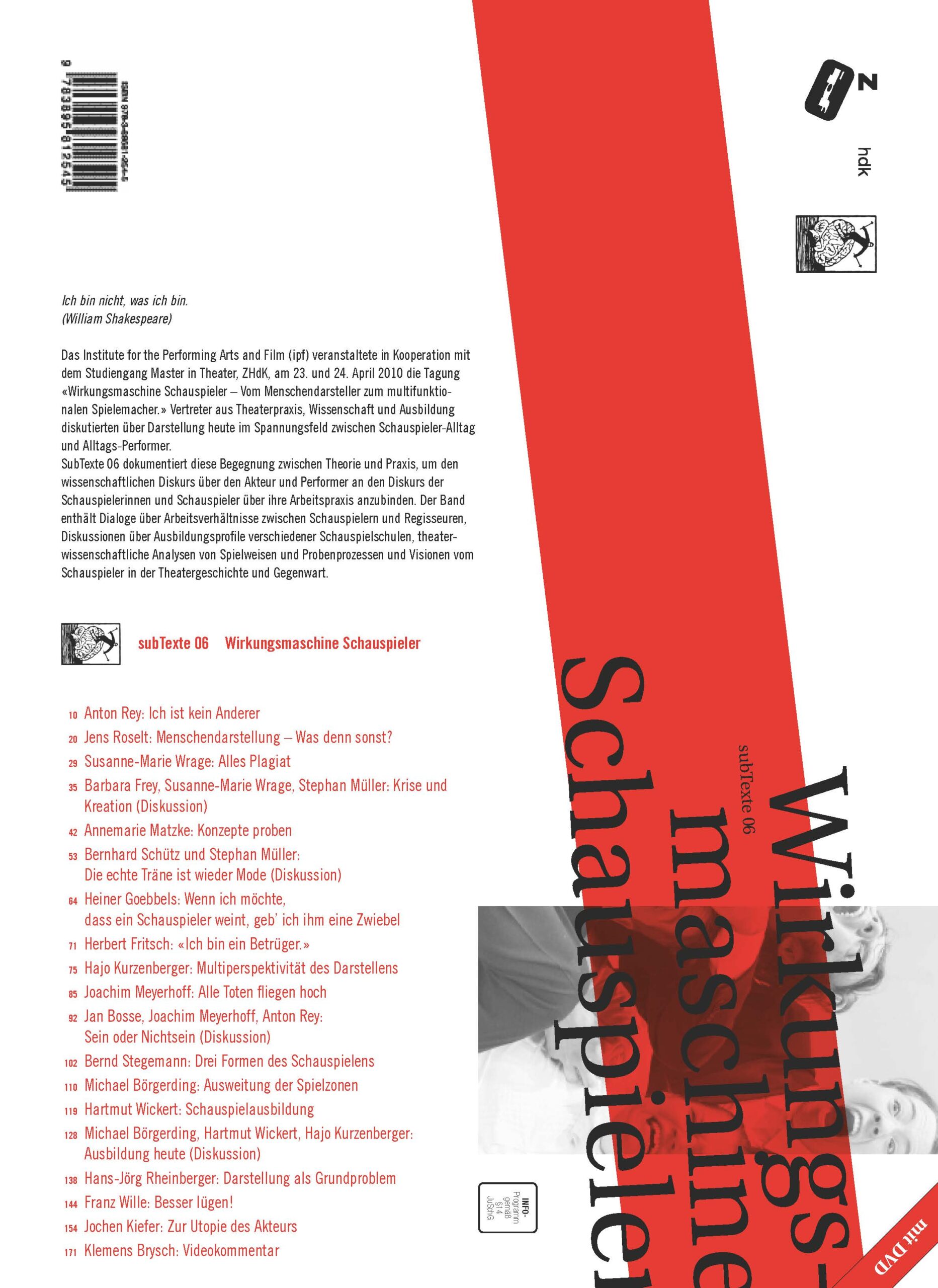
Vom Menschendarsteller zum multifunktionalen Spielemacher
Was macht Schauspielen heute aus? Vertreter aus Theaterpraxis, Wissenschaft und Ausbildung diskutieren über Darstellung im Spannungsfeld zwischen Schauspieler-Alltag und Alltags-Performer, über Arbeitsverhältnisse zwischen Schauspielern und Regisseuren, Ausbildungsprofile verschiedener Schauspielschulen, theaterwissenschaftliche Analysen von Spielweisen und Probenprozessen und Visionen vom Schauspieler in der Theatergeschichte und Gegenwart.
subTexte 06
170 Seiten, DVD, Alexander Verlag, 2011
ISBN 978-3-89581-254-5
Printausgabe vergriffen