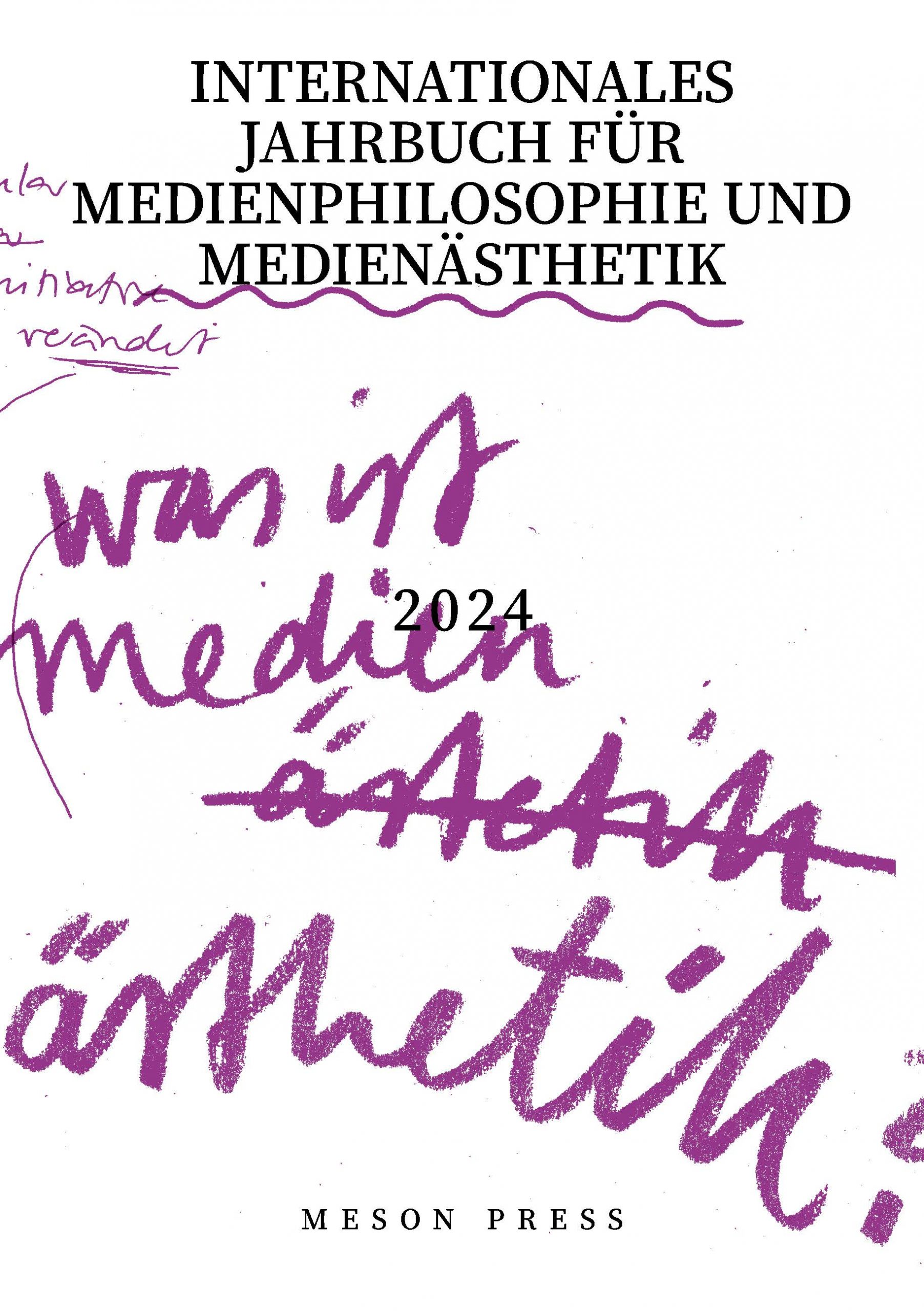
Internationales Jahrbuch für Medienphilosophie und Medienästhetik 2024 | Natascha Adamowsky, Judith Siegmund (Hg.)
CHF 40.50
Was ist Medienästhetik?
Als Nachfolger des früheren Internationalen Jahrbuchs für Medienphilosophie beschäftigt sich das Internationale Jahrbuch für Medienphilosophie und Medienästhetik in der ersten Ausgabe nach dem Relaunch mit der wesentlichen Frage: Was ist Medienästhetik?
Diese Frage steht für eine doppelte Öffnung: Medienästhetik markiert eine Suchbewegung, die die philosophischen wie medienwissenschaftlichen Grundlagen erkundet, die in medienästhetischen Kontexten in Erscheinung treten können.
232 Seiten, Meson Press, 2025
ISBN 978-3-95796-240-9
Das Jahrbuch bietet unterschiedlichen Projekten, Positionen und Fragestellungen Raum, die zueinander im Modus des Dissenses, der Überschneidung, der Assoziation, aber auch der inhaltlichen Weiterführung stehen können.
Internationales Jahrbuch für Medienphilosophie und Medienästhetik 2024 | Natascha Adamowsky, Judith Siegmund (Hg.) [E-Book PDF]
Was ist Medienästhetik?
Als Nachfolger des früheren Internationalen Jahrbuchs für Medienphilosophie beschäftigt sich das Internationale Jahrbuch für Medienphilosophie und Medienästhetik in der ersten Ausgabe nach dem Relaunch mit der wesentlichen Frage: Was ist Medienästhetik?
Diese Frage steht für eine doppelte Öffnung: Medienästhetik markiert eine Suchbewegung, die die philosophischen wie medienwissenschaftlichen Grundlagen erkundet, die in medienästhetischen Kontexten in Erscheinung treten können.
232 Seiten, Meson Press, 2025
ISBN 978-3-95796-240-9
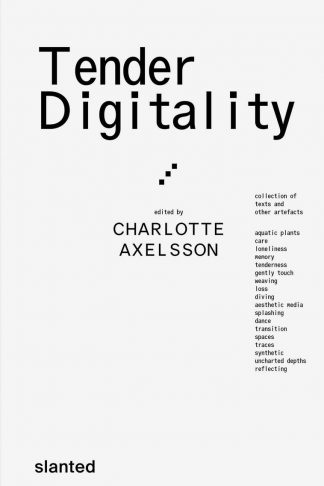
«Tender Digitality» beschreibt ein ästhetisch orientiertes Konzept, das ein binäres System in Schwingung versetzt und Menschen als Human Digitalus darstellt. Dabei reagiert es auf das Bedürfnis, Sinnlichkeit, Wahrnehmung, Intuition und Wohlbefinden in digitalen Umgebungen zu erleben, diese Erfahrung greifbar zu machen und dafür eine Sprache zu entwickeln.»Tender Digitality» operiert im Raum zwischen analog und digital, sozialen und technischen Phänomenen, welches es in sich ständig verändernde, niemals fixierte Muster einwebt.
Die Institute an der Zürcher Hochschule der Künste | Aracely Uzeda, Christoph Schenker (Hg.) [PDF]
Die Institute an der Zürcher Hochschule der Künste. Forschung, Dienstleistung, Weiterbildung / The Institutes of the Zurich University of the Arts. Research, Services, Continuing Education
Die vorliegende Publikation gibt einen Überblick über alle Institute an der ZHdK — über deren Arbeitsschwerpunkte in Forschung, Weiterbildung und Dienstleistung. Die Institute sind seit 2007, entsprechend ihren Forschungsschwerpunkten, den fünf folgenden ZHdK-Departementen zugeordnet: Departement Design, Departement Darstellende Künste und Film, Departement Kunst & Medien, Departement Musik sowie Departement Kulturanalysen und -Vermittlung.
Mit Beiträgen von Peter Geimer, Jörg Huber, Hannes Rickli und Sigrid Schade (dt./engl.)
176 Seiten (PDF), Zürcher Hochschule der Künste, 2008
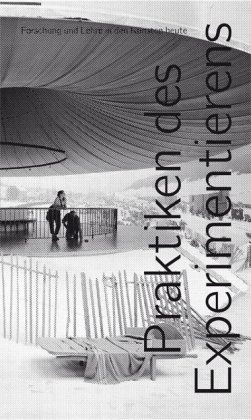
Praktiken des Experimentierens | Departement Kunst und Medien DKM (Hg.)
CHF 49.00
Forschung und Lehre in den Künsten heute
In den letzten Jahren hat sich das Departement Kunst & Medien (DKM) der Zürcher Hochschule der Künste ZHdK international einen Namen gemacht mit seiner Programmatik und seiner Praxis des Experimentierens in Lehre und Forschung. Das DKM umfasst einen BA-Studiengang Medien & Kunst – mit den Vertiefungen Bildende Kunst, Fotografie, Mediale Künste und Theorie -, einen Master of Fine Arts, in dem Künstler, Medienautoren und Theoretiker gemeinsam ausgebildet werden, sowie die beiden Forschungsinstitute für Gegenwartskünste und für Theorie. Dieses Dispositiv schafft einen einmalig dichten Raum zeitgenössischer Kunstausbildung und Kunstforschung in Europa. (dt./engl.)
Jahrbuch des Departements Kunst & Medien (DKM)
500 Seiten, Scheidegger & Spiess, 2012
ISBN 978-3-85881-259-9

![Internationales Jahrbuch für Medienphilosophie und Medienästhetik 2024 | Natascha Adamowsky, Judith Siegmund (Hg.) [E-Book PDF]](https://publikationen.zhdk.ch/wp-content/uploads/2025/06/202506_JahrbuchMedienaesthetik-324x486.jpg)