Handbuch «Designing Podcasts» | Hans Knobloch, Caroline Feder, et al. (Hg.) [E-Book PDF]
Nach ersten qualitativen Untersuchungen zum Nutzungsverhalten von Podcast-Usern haben ZHAW und ZHdK ein zweijähriges empirisches Forschungsprojekt entwickelt, das eine Verknüpfung von Mediendramaturgie (ZHdK) und Medienpsychologie (ZHAW) herstellt, um Podcasts aus dem Blickwinkel unterschiedlicher wissenschaftlichen Disziplinen besser zu verstehen.
Das Handbook erhebt den Anspruch, Gestaltung und Nutzung von Podcasts zusammenzudenken, den Blick auf das Ganze statt auf Einzelaspekte zu richten und so ein neues Bild der Podcastlandschaft im DACH-Raum zu zeichnen.
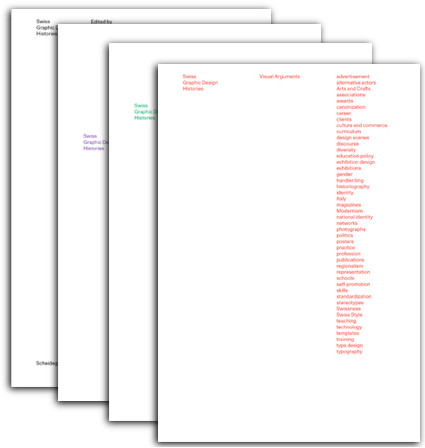
Swiss Graphic Design Histories | Sarah Owens et al. (eds.) [E-Book PDF]
Swiss Graphic Design Histories offers an entirely new redefinition of Switzerland’s graphic design landscape. Based on extensive research by scholars of design history and with a multiple and inclusive approach, it reaches beyond the usual canon and the well-known epicenters Basel and Zurich with the Germanophone fathers of what has become famous as the Swiss Style in the 1950s, 1960s and 1970s.
Edited by Davide Fornari, Robert Lzicar, Sarah Owens, Michael Renner, Arne Scheuermann and Peter J. Schneemann.
Architectonics of Game Spaces | Andri Gerber, Ulrich Götz (eds.)
CHF 48.70
What consequences does the design of the virtual yield for architecture and to what extent can the nature of architecture be used productively to turn game-worlds into sustainable places – over here, in «reality»?
This pioneering collection gives an overview of contemporary developments in designing video games and of the relationships such practices have established with the design of architecture. Due to their often simulatory nature, games reveal constructions of reality while positively impacting spatial ability and allowing for alternative avenues to complex topics and processes of negotiation. Granting insight into the merging of the design of real and virtual environments, this volume offers an invaluable platform for further debate.
343 pages, transcript, 2019
ISBN 978-3-8376-4802-7
Not at Your Service. Manifestos for Design | Björn Franke, Hansuli Matter (eds.)
CHF 52.90
Not at Your Service: Manifestos for Design brings together the broad spectrum of beliefs, subjects and practices of designers at Zurich University of the Arts. It offers different approaches and insights on the present-day role and impact of design. It is not conceived as a finished project, but as a fluid document of its time. Collaborative design, interaction within complex systems, attention economics, the ecological shift, visual literacy, gender-neutral design, «quick and dirty» design ethnography, social responsibility, the value of ugliness, death futures, immersive technologies, identity and crises, design as a transformative discipline – all of these topics are presented for debate with passion, conviction and professional expertise.
526 pages, Birkhäuser, 2021
ISBN 978-3-0356-2272-0

![Handbuch "Designing Podcasts" | Hans Knobloch, Caroline Feder, et al. (Hg.) [E-Book PDF]](https://publikationen.zhdk.ch/wp-content/uploads/2026/01/zhdk-DesigningPodcasts.png)
![Swiss Graphic Design Histories | Sarah Owens et al. (eds.) [E-Book PDF]](https://publikationen.zhdk.ch/wp-content/uploads/2022/03/Swiss-Graphic-Desihn-Histories-324x448.jpg)




![Handbuch "Designing Podcasts" | Hans Knobloch, Caroline Feder, et al. (Hg.) [E-Book PDF]](https://publikationen.zhdk.ch/wp-content/uploads/2026/01/zhdk-DesigningPodcasts-324x486.png)