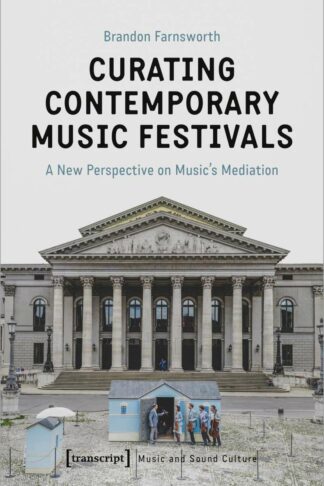
Curating Contemporary Music Festivals | Brandon Farnsworth [E-Book PDF]
A New Perspective on Music’s Mediation
Contemporary music, like other arts, is dealing with the rise of «curators» laying claim to everything from festivals to playlists – but what are they and what do they do anyway? Drawing from backgrounds ranging from curatorial studies to festival studies and musicology, Brandon Farnsworth lays out a theory for understanding curatorial practices in contemporary music, and how they could be a solution to the field’s diminishing social relevance. The volume focuses on two case studies, the Munich Biennale for New Music Theatre, and the Maerzmusik Festival at the Berliner Festspiele, putting them in a transdisciplinary history of curatorial practice, and showing what music curatorial practice can be.
326 pages (PDF), transcript, 2020
ISBN 978-3-8394-5243-1
This work is an adaptation of the dissertation “Curating Festivals for Contemporary Music” submitted in partial fulfillment of the requirements for the degree of Doctor of Philosophy at the Hochschule für Musik Carl Maria von Weber Dresden.
With support from the Zurich University of the Arts, Institute for Theory (ith)
Curating Contemporary Music Festivals | Brandon Farnsworth
CHF 55.90
A New Perspective on Music’s Mediation
Contemporary music, like other arts, is dealing with the rise of «curators» laying claim to everything from festivals to playlists – but what are they and what do they do anyway? Drawing from backgrounds ranging from curatorial studies to festival studies and musicology, Brandon Farnsworth lays out a theory for understanding curatorial practices in contemporary music, and how they could be a solution to the field’s diminishing social relevance. The volume focuses on two case studies, the Munich Biennale for New Music Theatre, and the Maerzmusik Festival at the Berliner Festspiele, putting them in a transdisciplinary history of curatorial practice, and showing what music curatorial practice can be.
326 pages, transcript, 2020
ISBN 978-3-8376-5243-7
Eventisierung der Stadt | Gabriela Muri, Daniel Späti, Philipp Klaus, Francis Müller (Hg.)
CHF 49.90
Events sind ein fester Bestandteil unseres Alltags geworden. Sie werden professionell geplant, mittels ausgeklügelter Dramaturgie gestaltet und vermitteln ein Gefühl von Exklusivität. Der Eventbegriff steht für ein spezifisches Spannungsfeld zwischen ökonomischen Verwertungskontexten und populären Praxisdimensionen. Vor dem Hintergrund dieser begrifflichen Unschärfe legt das Buch den Fokus auf Prozesse der Stadtentwicklung sowie das normative Potenzial von Mustern der Eventproduktion und -rezeption. Damit werden zum einen Stadtentwicklung und Eventproduktion als Treiber von Exklusionsprozessen verstanden. Zum anderen wird Eventisierung als ein Ineinandergreifen von Produktions- und Rezeptionsprozessen gesehen. Wir nehmen alle mehr oder weniger aktiv an Prozessen der Eventisierung teil und nehmen sie meist auch dankbar hin. Die Kehrseiten der Eventisierung und die Ungleichheiten, die sie hervorrufen, bleiben allerdings mehrheitlich unsichtbar. Am Beispiel von Zürich wird daher der Frage nachgegangen, wie Eventkulturen Prozesse und Praxen gesellschaftlicher Selbstverständigung neu ordnen und vernetzen.
Zone. Medienphilosophische Exkursionen | Michael Mayer
CHF 25.00
Logik, Funktion und Praxis der Grenze gehören zum festen Inventar abendländischen Denkens. Grenzen zu setzen gilt als Ausdruck disziplinierender Fürsorge, sie zu übertreten als Provokation, ihre Sicherung als primärer Akt staatlicher Souveränität. Stets geht es um eine Demarkation, die den Unterschied macht und das Unterschiedene. Inspiriert vom Bild der Zone, das Andrej Tarkowskij in seinem Film »Stalker« entwirft, erprobt der Band eine andere Geste: Wir überschreiten keine Grenzen mehr, wir betreten Zonen – jenen »Raum«, der stets »dazwischen« liegt, jenes Dritte als Mitte und Mittleres, als Medium.
Aisthetik der Müdigkeit | Fabian Goppelsröder [E-Book PDF]
In einer Zeit, in der Aktivität und Leistung alles bedeuten, da power naps und polyphasischer Schlaf die Nachtruhe optimieren sollen, Klartraumtechniken Ressourcen zur Verbesserung körperlicher und geistiger Effizienz kolonisieren, lässt sich – so scheint es – für die Müdigkeit kaum noch argumentieren. Das Sensorium für ihre Fülle ist durch all den Optimierungsdruck verkümmert. Der Imperativ des 24/7 hat es anästhesiert. Dabei geht es heute, so der Ansatz des vorliegenden Buches, mehr denn je darum, ihre besondere Aisthetik wiederzuentdecken, den Sinn für die ihr eigenen Zwischenzustände des Ungeformten und Nichtkategorisierbaren zu wecken.

![Curating Contemporary Music Festivals | Brandon Farnsworth [E-Book PDF]](https://publikationen.zhdk.ch/wp-content/uploads/2020/10/Curating-Contemporary-Music-Festivals-.jpg)

![Aisthetik der Müdigkeit | Fabian Goppelsröder [E-Book PDF]](https://publikationen.zhdk.ch/wp-content/uploads/2019/04/image-1-324x486.png)
