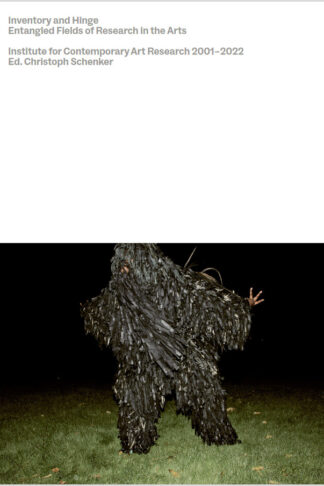
Inventory and Hinge | Christoph Schenker (ed.) [E-Book PDF]
Entangled Fields of Research in the Arts: Institute for Contemporary Art Research 2001-2022
Inventory and Hinge provides an overview of the research projects performed over the last two decades at the Institute for Contemporary Art Research (IFCAR) of Zurich University of the Arts (ZHdK). It is an inventory because it presents all the projects realized during this period with many figures and illustrations. It is a hinge because links and QR codes grant access to nearly all publications and websites that were created by the individual projects.
Artistic work interconnects multiple competencies and areas of knowledge, ways of life and working, and the IFCAR research projects are thus organized in correspondence with this transgressive gesture, which becomes manifest here as interdisciplinary, networked knowledge production. The cultivation of these complexities has been a mission of the IFCAR since its inception.
Throughout these pioneering years the IFCAR has always seen its task in the promotion of research competency in the fine arts, and in providing support for the conception and execution of concrete projects. Although art as research has a long tradition outside of institutions, this task meant nothing less than introducing a new research discipline into the context of knowledge and establishing a new genre in the context of art. Each of the projects presented in this book involves research through the process of creation—but they often also conduct a metadiscourse on artistic research itself.
ZHdK: Institute for Contemporary Art Research (IFCAR)
Entangled Fields of Research in the Arts: Institute for Contemporary Art Research 2001-2022
Inventory and Hinge provides an overview of the research projects performed over the last two decades at the Institute for Contemporary Art Research (IFCAR) of Zurich University of the Arts (ZHdK). It is an inventory because it presents all the projects realized during this period with many figures and illustrations. It is a hinge because links and QR codes grant access to nearly all publications and websites that were created by the individual projects.
Kunst des Forschens. Praxis eines ästhetischen Denkens | Elke Bippus (Hg.) [E-Book PDF]
Künstlerische Forschungen können zu den Verfahren gezählt werden, die auch ein «implizites Wissen», Brüche und Ungeklärtes fruchtbar machen. Solche Aspekte stehen in Widerspruch zu einer Zeit, in der das Bildungsideal Humboldts einer Ökonomisierung weichen und Wissen als neue Form des Kapitals verfügbar sein soll. Bruce Nauman hat Kunst als ein «Instrument» beschrieben, «mit dem man sich eine Aktivität des Erforschens aneignen kann». Forschen ist in diesem Sinne als Aktivität vorgestellt, welche die übliche Asymmetrie zwischen wissendem Forscher und Anwender unterbricht und damit eine politische Komponente gewinnt.
Wie ist das Verhältnis zwischen Kunst und Politik heute? Erzielt engagierte Kunstproduktion Wirkungen im öffentlichen, politischen Raum? Wie ist es um die Lesbarkeit von visuellen Botschaften in Kunst und Kultur bestellt? In jüngster Zeit treten zunehmend mehrdeutige und unentschiedene Codes und Zeichen an die Stelle einer klaren und deutlichen Bildsprache. Während die einen dafür die Komplexität der Inhalte und Vielfalt der Formen verantwortlich machen, interpretieren andere dies als politische Strategie der Verweigerung gegenüber einer Instrumentalisierung. Der Tenor der Kunstkritik ging in den letzten Jahren sogar so weit, die Uneindeutigkeit zum Qualitätsmerkmal gehaltvoller Kunst schlechthin zu erheben. Die in dieser Publikation versammelten Aufsätze hinterfragen das Phänomen »Ambivalenz« aus kritischer Perspektive und untersuchen seine Mechanismen und gesellschaftlichen Funktionen.
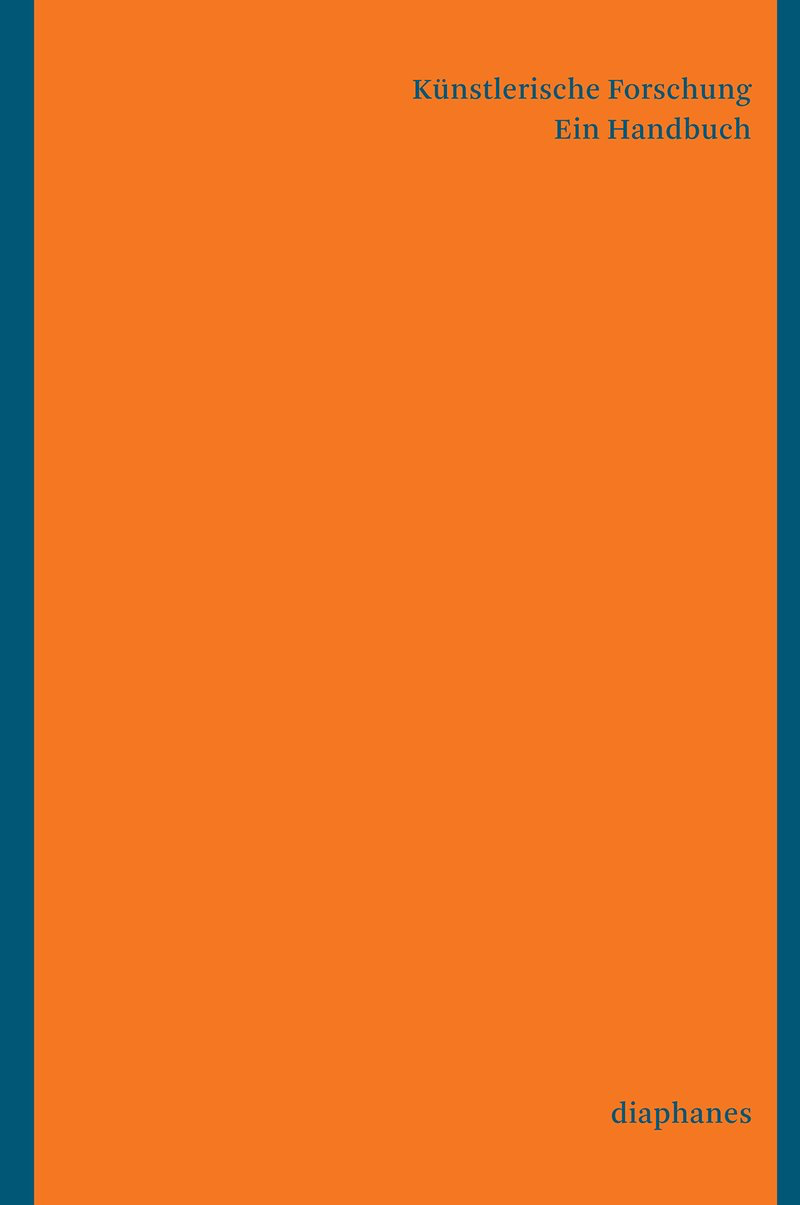
Künstlerische Forschung. Ein Handbuch | Jens Badura, Selma Dubach et al. (Hg.)
CHF 45.00
Die Debatte um »Künstlerische Forschung« hat einen hohen Grad an Differenzierung erreicht, sei es in ihrer allgemeinen, theorieorientierten Dimension, sei es auf der Ebene der Praxis des künstlerischen Forschens selbst. Alles deutet darauf hin, dass sich die Künstlerische Forschung an der Schwelle zu einer Institutionalisierung befindet. Ziel des Bandes ist es nicht nur, eine Bestandsaufnahme der unterschiedlichen Frage- und Themenstellungen zu erstellen, sondern auch jene Kontroversen abzubilden, aufgrund derer man den Prozess einer vorschnellen »Disziplinierung« der künstlerischen Forschung kritisch betrachten mag. Entlang einiger Leitfragen entwirft der Band eine Topographie des gesamten Feldes der Debatte um künstlerische Forschung.
344 Seiten, Diaphanes, 2015
ISBN 978-3-03734-880-2
![Inventory and Hinge | Christoph Schenker (ed.) [E-Book PDF]](https://publikationen.zhdk.ch/wp-content/uploads/2023/01/Inventory-and-Hinge.jpg)
![Kunst des Forschens. Praxis eines ästhetischen Denkens | Elke Bippus (Hg.) [E-Book PDF]](https://publikationen.zhdk.ch/wp-content/uploads/2019/05/image-3-324x486.png)